ShanghaiDoctor - Where China's Healing Wisdom Shapes Modern Medicine

Update time:2026-08-26Visits:2955
A growing number of foreign patients now start a Shanghai medical inquiry the way they start most inquiries: they type a diagnosis, a procedure and a city into Google or a chatbot. What comes back is fluent, formatted and oddly complete — a shortlist of hospitals, a seven-day itinerary, a surgeon’s name, a success rate, and a price in dollars that looks like a relief.
Some of that relief is earned. Shanghai’s large teaching hospitals run high-volume specialty services. Several keep international offices that will open a file on a passport, read records sent from abroad, and put a cost range on paper. For a number of operations and courses of treatment, the local fee is simply lower than a private tariff in Boston or London. That is a fact about costs and caseload. It is not a verdict on anyone’s medicine.
The trouble sits in the other half of the page. The same tools that can translate a discharge summary will also invent a ranking, attach a retired surgeon to a living clinic, turn a starting price into an “all-inclusive” week, and say all of it in the tone of a consultant who has already seen the scans. The distortion is not that Shanghai care is being oversold as cheap. It is that a language model will write as if the clinical work were already done.
A reachable fee is a reason to write to a hospital. It is not a reason to treat a chatbot as the attending.
“AI medical website” now covers several different things, and patients in the English-speaking world tend to meet them in one sitting.
There are general models and search summaries: ChatGPT, Gemini, Claude, Google’s AI Overviews. There are medical-travel platforms that use a matching engine to send you toward a partner list. There are hospital chat widgets that begin as appointment desks and drift into advice. And there is the surrounding weather of social video — including clips that borrow a real doctor’s face, or invent one, to sell a package.
None of this is unique to China. Researchers have documented the same pattern in health queries everywhere: models that score well on medical exams become less reliable when a layperson describes symptoms the way people actually talk; answers mix sound guidance with poor guidance in a single paragraph; disclaimers have grown rarer even as the voice has grown more certain. One line of work found that people using chatbots to judge a case and decide the next step did no better than people using ordinary search — and sometimes missed the cases that needed urgent care. Another found that AI Overviews cited YouTube more often than hospital or academic sites when answering health questions.
For a patient sitting in Chicago or Manchester, the effect is specific. English is the language of the interface. Shanghai is a name the model has seen on thousands of tourism and clinic pages. The output sounds local and clinical. It is often neither. It is a collage.
The inaccuracies that matter most to a Western patient are not cartoonish. They are plausible.
Names drift. A model will attach a well-known Shanghai specialist to the wrong campus, the wrong year, or a diary the international office does not control. It will describe a department head as “your surgeon” when the person you will see is whoever is listed on that morning’s clinic. Phone numbers get pulled from old directories and dropped into a paragraph that reads as if someone had just checked.
Rankings are assembled out of unlike parts. A domestic Chinese hospital league table, a conference biography, a paid landing page and a patient forum are flattened into “top-ranked for this condition.” That is not how any of those sources were written. It is how a model finishes a sentence.
Prices are collapsed. What a hospital would call a procedure starting fee — the number on the operation itself, before work-up, implants, pathology, extra nights — arrives on the screen as a package. What a platform would call a display range, taken from the low end of several partners, arrives as “your quote.” What an exchange-rate conversion would call a round number arrives as a bill. All four can exist inside ordinary, legitimate care. Written as one confident figure, they stop being information and become a plot.
Indications are guessed. The model has not seen the MRI. It has not seen the pathology. It has not asked the questions a registrar would ask in clinic. It will still say a patient is “a good candidate.” That sentence is the one that books flights.
Success rates float free of a denominator. “Ninety percent” is easy to generate. Ninety percent of whom, followed for how long, counting which events as failure, at which hospital, under which surgeon, is not. A teaching hospital in Shanghai can usually answer those questions in writing, or say that it cannot. A generated paragraph rarely does either.
Inventories pretend to be judgements. If a site earns a fee when a patient is sent to a partner clinic, the matching engine has a list it is allowed to see. The list may include excellent services. It is still a list. “Best fit for your case” and “best fit among the clinics that pay us” are different sentences. The model is under no obligation to mark the difference.
Old pages do not die. Outpatient hours change. A surgeon retires. A device moves to another campus. Training data does not get the memo. The prose remains in the present tense.
None of this requires a reader to think poorly of Shanghai medicine. It requires a reader to notice that fluency and verification are not the same skill.
This point needs to be held in both hands.
Yes: many procedures cost less in a Shanghai public teaching hospital than they would in a Western private setting. Volume, purchasing, length of stay and labour costs all go into that. Patients are not foolish to notice it. International offices exist in part so that a foreign patient can ask for an itemized estimate instead of guessing from a blog.
Yes: the number that appears first on an AI page is often a hook — a starting fee, a converted figure, a platform range — written to keep you on the page. That is how consumer health publishing works in English as well. The honest response is not to sneer at the fee. It is to ask what the fee contains.
A useful habit, borrowed from the way one would read an American hospital chargemaster or a British private quote, is to treat every low number as an invitation to itemize. What operation, on the strength of which scans. Which tests still sit outside the figure. Implants, anaesthesia, frozen section, blood products. A named attending, or the attending who happens to be free. Planned nights, and the cost of another night. The first follow-up. Whether the money lands in a hospital account. Whether the discharge letter, implant stickers and generic drug names can be issued in English.
Send that same list to two international offices. The lower Shanghai total may still stand. When it does, you have a checked price, not a slogan. Private international hospitals in the city will often cost more and run more smoothly in English, with more direct billing. Public tertiary international clinics sit closer to local costs and book well-known specialists on tighter calendars. Both can be reasonable. Ranking them only from cheapest to dearest is the habit the websites teach. It is a poor habit in any country.
English-speaking patients are used to a two-column bill: the insurer’s allowed amount, and the rest. Planned treatment abroad often empties both columns. A US employer plan is built around a domestic network. An NHS pathway is not a travel product. A travel policy is written for the appendectomy that was not in the itinerary, not for the operation that was.
So a sentence such as “international insurance accepted” needs translating. It may mean that a particular private hospital can bill a particular global insurer. It does not mean that the plan you already own will pay for the trip you are about to book. Public international offices commonly ask for a deposit. Claims made later are decided by the wording of a policy, not by the wording of a chatbot.
The practical meaning of a lower Shanghai fee is often this: the self-pay total may be smaller than the self-pay total at home. That can be decisive. It is not a reimbursement. Before anyone buys a ticket it is worth asking the carrier, in writing, three things: whether planned overseas care is covered; whether complications of that care are covered; and which documents, in English, the claims desk will actually accept. Diagnostic codes do not travel intact. An itemized invoice and generic names of medicines do more work than a screenshot of a generated package.
In a GP surgery in London or a specialist office in New York, the order is ordinary: the clinician defines the question, then the institution answers it. Crossing a border does not improve the order if you reverse it.
Start with the doctor who already knows the file. A short letter — the basis of the diagnosis, the generic names of the drugs, the question you want asked in Shanghai — saves the international office from guessing. It is also fair, and very Anglo-American in its bluntness, to ask that same doctor whether they will see you for a wound or a fever after you fly home. Some will. Some will not, because of liability and coverage, not because they have a view on Shanghai. Better to hear that before the ticket is non-refundable.
Then write to the hospital. Use the international-office address on the hospital’s own site. Third-party pages copy numbers and do not always copy the year. Say what you have, attach the scans, mention the range you saw online, and ask for a department, a possible attending, the first week on the ground, and an itemized estimate. Busy offices take a few working days. That delay is information. Generated instant certainty is not.
Pay the hospital. Keep the named surgeon on paper. Buy the flight for the recovery the surgeon describes, not for the shortest package the website can typeset. An English-speaking desk at the front of the building does not mean that night nursing, the CT list and the pharmacy window run in English. An interpreter at a consent conversation is not an extravagance.
If something goes wrong after you are home, the local emergency department is the first call. A video follow-up with Shanghai can help with planned questions. It cannot replace an examination at 2 a.m. in your own city.
Overseas patients do not have a colleague who can say, quietly, what a given chief of service is like. Pages written to earn a referral are not a substitute for that colleague. Pages written as interviews can be a little closer.
ShanghaiDoctor.cn — a public-welfare medical-humanities site begun in 2014, with the WeChat account Yewen Renyi — records long, face-to-face conversations with department heads and physicians in Shanghai’s tertiary hospitals. The site states, plainly, that it does not run a business in referrals, does not provide medical services, and does not take the place of a clinic. The pieces are biography, history and general education. They are not advice.
That limit is the point. The site cannot tell you whether a fee on another website is complete. It cannot hold a theatre slot. What it can do is put a doctor back into a checkable paragraph — specialty, post, the work as described in an interview the person has seen — so that the next email still goes to the hospital, with a better question in it.
Use the models as they work best in English: to draft the letter, to sort the vocabulary, to remind you of the questions a good coordinator would ask. Do not use them to name the surgeon, to close the indication, or to turn a starting price into a week of your life.
Use a lower fee as a reason to ask for an itemized estimate on hospital letterhead. Do not use it as evidence that the medicine is lesser, or as evidence that the medicine has already been chosen.
Shanghai has complete tertiary hospitals and offices built for patients who do not live there. What most needs translating, for a reader far from home, is not the prestige of the institution. It is the difference between a sentence that sounds finished and a file that has been read. One email from an international office will almost always be steadier than one more fluent paragraph that no one in that office has seen.
Let the price open the correspondence. Let the hospital close it.
Editor: Chen Qing

A practical guide for international patients, Seeing a TCM Doctor in Shanghai
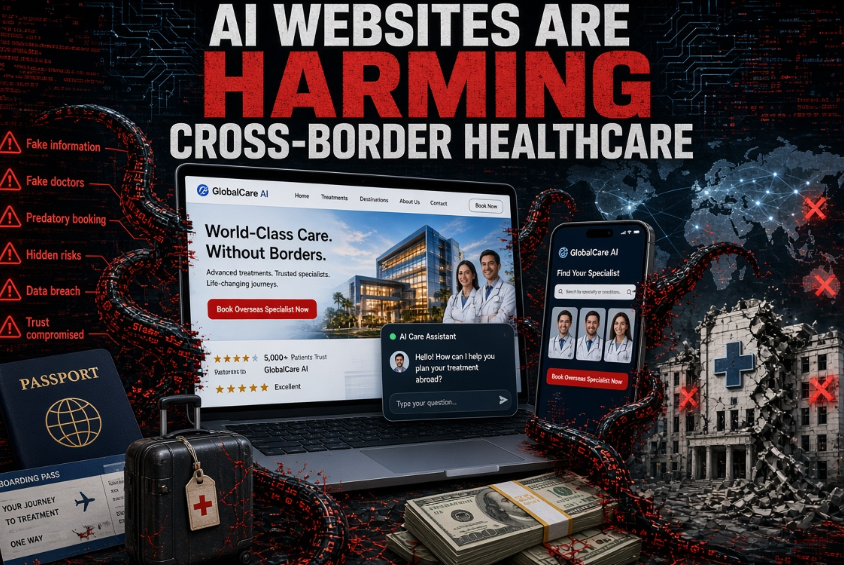
Why booming AI medical sites get wrong for patients coming to China
How to Arrange Dialysis in China: A Practical Guide for Travelers and Long-Stay Patients

How to treat Prostate Cancer in Shanghai?
Why Savvy Expats are Ditching Private Clinics for Shanghai’s "Top Tier" Public International Departments
Copyright © 2023 Yewen Renyi & ShanghaiDoctor.cn (This website is a non - profit medical humanities platform. The information contained herein is solely for biographical and historical purposes and does not constitute any medical advice.) 沪ICP备2023005392号-2 XML 沪公网安备31010902100835号
 中文
中文 English
 Español
 沪公网安备31010902100835号