ShanghaiDoctor - Where China's Healing Wisdom Shapes Modern Medicine

Update time:2026-03-12Visits:5163
On the eve of International Women’s Day, Fudan University’s Obstetrics and Gynecology Hospital presented a “smart health” gift to women—the official launch of “Red House · Qiyuan,” an AI vertical large model designed specifically for obstetrics and gynecology. At the launch event, a striking demonstration unfolded in which doctors and AI worked side-by-side, simulating the full patient journey from pre-diagnosis through to post-diagnosis care, sparking considerable anticipation for this innovation.
During the demonstration, a 41-year-old patient arrived holding an “HPV16 positive” test report, anxiously asking about her condition, the appropriate department, and next steps. The “Xiao Hong” AI patient assistant promptly offered professional guidance, advising her to schedule an LCT examination without delay. Once the patient completed the test, she moved to the colposcopy room. As the lead physician carefully performed the procedure, the integrated “Multimodal Cervical Cancer Diagnosis and Treatment Intelligent Agent” operated in parallel, swiftly identifying lesions under the microscope and suggesting a tailored diagnostic and treatment pathway. Six months later, the patient received an automated follow-up reminder and a pre-consultation link. This seamless end-to-end process showcased the model’s powerful practical application.

Professor Jiang Hua, President of Fudan University’s Obstetrics and Gynecology Hospital, noted that unless specialized medical expertise can be structurally encoded and systematically accumulated, even the most advanced AI remains merely a tool. What hospitals truly need, he emphasized, is a foundational platform capable of accumulating such specialized knowledge—and “Red House Qiyuan” was conceived precisely to meet this need. Professor Jiang Yugang, Vice President of Fudan University, added that Fudan will continue to deepen integration between medicine and engineering, enhance computing platform support, strengthen collaboration among hospitals, universities, and industry partners, and promote the standardized and safe development of medical artificial intelligence.
Developed jointly by Fudan University’s Obstetrics and Gynecology Hospital and Alibaba Cloud, the “Red House · Qiyuan” AI model adopts a three-tier architecture: a “domestic foundational layer + specialized alignment layer + scenario-based intelligent agents.” It achieves three key breakthroughs: “reconstructing knowledge expression, redesigning clinical reasoning mechanisms, and reimagining workflow integration.” By doing so, it tackles persistent industry challenges such as fragmented AI applications in women’s health, inconsistent data standards, and limited professional depth—advancing AI in obstetrics and gynecology from “single-point intelligence” to “system-wide intelligence.”
At the foundational level, the model is built on heterogeneous computing power and Alibaba’s Tongyi Qianwen, establishing a secure, controllable domestic base with robust multimodal understanding and reasoning capabilities. Already, the “Xiao Hong” AI patient assistant, developed on this platform, has completed Shanghai’s first generative AI filing in the medical service sector.
The core of the model lies in its intermediate knowledge layer. To overcome the lack of specialized expertise in general AI models and reduce inaccuracies or “hallucinations,” the system integrates high-quality obstetrics and gynecology data—including millions of clinical cases, thousands of guidelines and consensus documents, internal teaching materials, and specialized resources. Through structuring core treatment pathways, consolidating fragmented data, building specialized knowledge graphs, and unifying semantic rule mapping, it achieves a leap forward in knowledge representation. Simultaneously, via specialized alignment training, it embeds standardized diagnosis and treatment pathways, quality control rules, and the clinical reasoning patterns of senior obstetricians and gynecologists throughout the process, establishing an evidence-based, standardized response system for women’s healthcare.
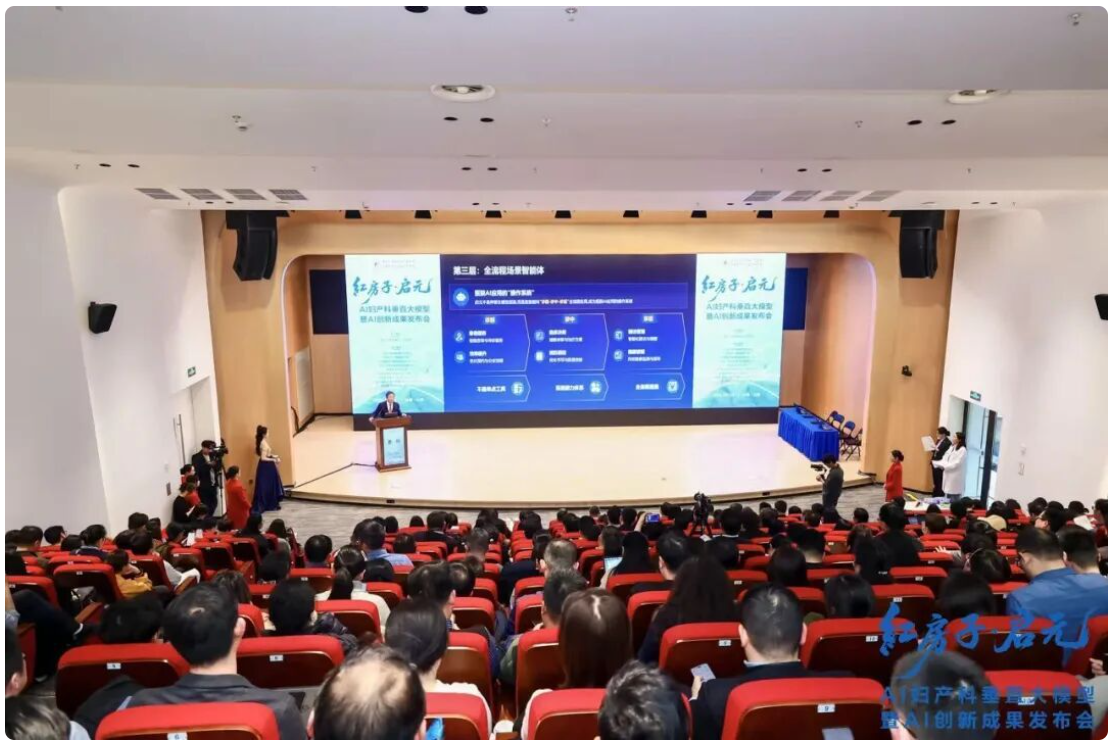
Supported by a dedicated foundation, "Red House Qiyuan" is a highly adaptable platform designed for medical institutions and community-based maternal and child health services. It also provides interfaces for future diverse applications in research and industry. The hospital has now built an AI ecosystem on this foundation, focusing on three key areas: smart management, smart services, and smart healthcare.
One application, "Little Red," excels in interpreting medical reports, intelligent patient triage, post-operative recovery guidance, and long-term follow-up. It demonstrates not only precision and efficiency but also a nuanced capacity for emotional perception. Another tool, the "Multimodal Cervical Cancer Diagnosis and Treatment Intelligent Agent," can analyze colposcopy images, automatically annotate lesions, and accurately predict risks, offering reliable decision-support for clinicians in community settings.
Additionally, a suite of other applications has been deployed, including systems for the precision consultation and risk assessment of hereditary gynecological tumours, AI-driven digital tools for maternal mental health, and an intelligent donor matching system for sperm banks. These innovations deeply integrate the hospital’s clinical expertise, technological advancement, and public health needs, extending the reach and efficiency of high-quality medical resources.
At the platform’s launch event, the hospital signed agreements with 19 medical institutions across the Yangtze River Delta region and 9 corporate partners, formally establishing the nation’s first obstetrics and gynecology digital intelligence innovation alliance—the "Red House Digital Intelligence Innovation Alliance." The alliance, which received a donation of domestic computing power resources from the Shanghai Health Data Industry Association, will create a collaborative platform for industry, academia, research, and clinical application. Centered on the Qiyuan AI vertical large model for obstetrics and gynecology, it aims to foster sustainable, interdisciplinary innovation to bridge the final gap in optimizing medical resource allocation.
A concurrent industry roundtable, titled "Establishing a New Order in Digital Healthcare," brought together hospital representatives with peers from companies such as Winning Health and from community hospitals. They explored the future of digital transformation in women’s healthcare, reaching consensus on six priority areas: foundational regulations, data security, computing power infrastructure, smart operations, patient services, and grassroots capacity building. Participants agreed that developing specialized AI vertical large models requires ecosystem-wide collaboration and shared standards.
In its innovative approach, the hospital has moved beyond traditional industry partnerships by proactively integrating high-quality corporate resources. Through initiatives like AI marketplaces and innovation competitions, it connects technological needs with industrial solutions, cultivating an open, collaborative environment. Evolving from a hospital-specific project into an industry-wide foundation, "Red House · Qiyuan" is accelerating the realization of AI's potential.
Hospital President Jiang Hua stated that going forward, the institution will align closely with national strategies for developing new quality productive forces and "AI +" initiatives. It will deepen cooperation with industrial, corporate, and research partners to strengthen the development and application of AI technologies. By harnessing the power of "Qiyuan," the hospital aims to provide a "Red House Solution" for the intelligent advancement of obstetrics and gynecology care, safeguarding women’s health throughout their lives.
Shanghai Trains 24 Top Hospitals on Cross-Border Payments for International Patients
A Second Life in Shanghai: How a 79-Year-Old American Traveler Was Saved
Canton Fair Opens Its First International Medical Service Zone
The World’s First Invasive Brain-Computer Interface Just Got Approved in Shanghai
A Shanghai Hospital Launches Vertical Large Model for Women’s Health
Shanghai Research Team Develops AI Diagnostic System for Rare Diseases with “Explainable” Reasoning
“Yi Jian Kang” Foundation Established by Professor Wen Yumei Celebrates 13 Years of Impact

Shanghai Trains 24 Top Hospitals on Cross-Border Payments for International Patients
A Second Life in Shanghai: How a 79-Year-Old American Traveler Was Saved
Canton Fair Opens Its First International Medical Service Zone

Shanghai Moves Its Best Hospitals Outward
The World’s First Invasive Brain-Computer Interface Just Got Approved in Shanghai

A Shanghai Hospital Launches Vertical Large Model for Women’s Health
Shanghai Research Team Develops AI Diagnostic System for Rare Diseases with “Explainable” Reasoning

World’s First “Video Camera” MRI is set in Shanghai, Ushering in the Era of Dynamic Physiological Imaging

“Yi Jian Kang” Foundation Established by Professor Wen Yumei Celebrates 13 Years of Impact

Renji International Medical Marks 20th Anniversary
Copyright © 2023 Yewen Renyi & ShanghaiDoctor.cn (This website is a non - profit medical humanities platform. The information contained herein is solely for biographical and historical purposes and does not constitute any medical advice.) 沪ICP备2023005392号-2 XML 沪公网安备31010902100835号
 中文
中文 English
 Español
 沪公网安备31010902100835号