ShanghaiDoctor - Where China's Healing Wisdom Shapes Modern Medicine

Update time:2026-11-14Visits:88
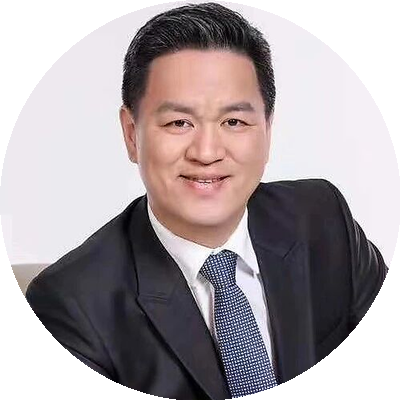
“Although the operation was hard and the process difficult, the result was satisfying. Endoscopic minimally invasive treatment can greatly improve the patient’s quality of life after surgery.”
— Zhong Yunshi
Zhong Yunshi is a Chief Physician and Deputy Director of the Endoscopy Center at Zhongshan Hospital, Fudan University, and Director of the office of the Shanghai Engineering Research Center for Digestive Endoscopic Diagnosis and Treatment. He specializes in endoscopic resection of early gastrointestinal cancers and submucosal tumors, ERCP for biliary and pancreatic disease, POEM for achalasia, and combined laparoscopic-endoscopic procedures. Over about five years he has completed more than three thousand endoscopic submucosal dissections (ESD), more than three thousand ERCPs, about three hundred POEM procedures, and more than one hundred combined laparoscopic-endoscopic operations. He has been selected for Shanghai’s “Rising Star” program of the Science and Technology Commission and has received a first-class Silver Snake Award and recognition among Shanghai’s outstanding young health workers.
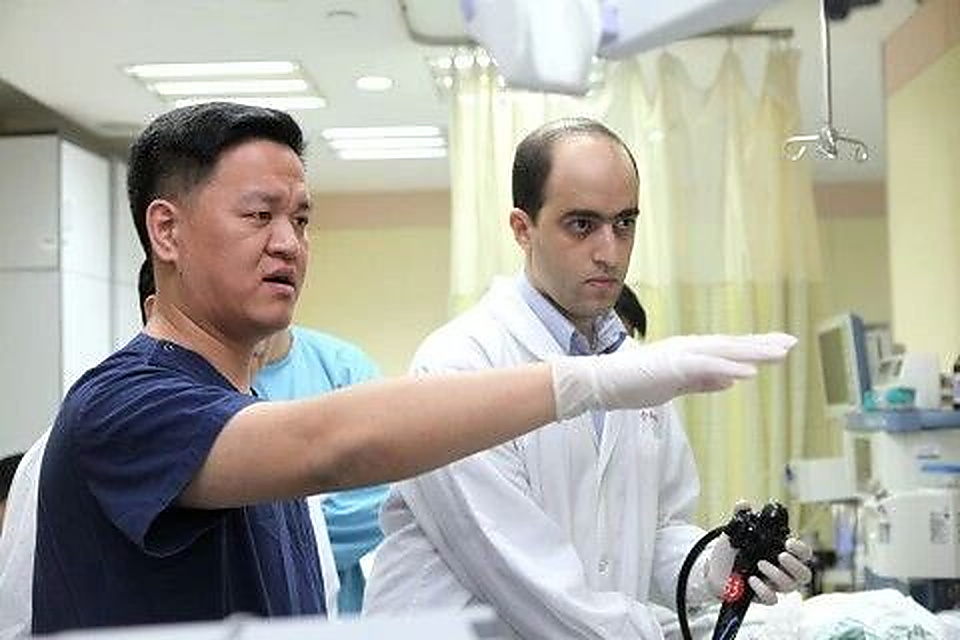
Zhongshan Hospital’s endoscopy center is known worldwide for the volume and quality of its endoscopic surgery. Methods that “dig tunnels” or “clear turf” under the mucosa were developed there, and several techniques now carry Chinese names rather than only European or American ones. Colleagues call Zhong Yunshi a “small sharp knife” in that innovative team. He was the first to report combined dual-scope treatment of gastrointestinal tumors at an international level; a method he advanced was named the “Zhong technique” at a world congress of endoscopic surgeons; and tunnel resection of esophageal tumors and the use of metal clips with nylon loops to close large wall defects after endoscopy were among the first of their kind, later cited in European guidance.
Behind the titles sits a simple habit: his workload is several times that of many peers, and he is often the last doctor to leave the center each day.
An elderly man from rural Zhejiang bled from a benign colorectal tumor fifteen centimeters across, sitting close to the anus. Local surgeons told the family the only open option was to remove the anus, or else watch and wait. The man would not accept that. With his four sons he came to Zhongshan. “Father worked hard all his life to raise us,” the sons said. “We hope the trauma can be smaller, and that his anus can be kept.”
Zhong was moved by their frankness and chose the risk of endoscopic resection. The case lasted three hours. Through the scope he stripped the tumor free and spared the anus; the next day the man could walk. The resection later received a Great World Guinness certificate as the largest colorectal endoscopic submucosal dissection of its kind.
As his name spread, more of the patients who sought him out were older, sicker, or burdened with many other diseases. He did not step back.
A patient over one hundred years old arrived in the emergency room with ongoing abdominal pain, nausea, vomiting and fever. Imaging showed common-bile-duct stones. Leaving them would risk repeated infection and fatal cholangitis. Open surgery at that age was unlikely to be survivable. The team chose ERCP stone removal. In under thirty minutes Zhong cannulated the duct through the duodenal papilla and cleared the stones.
Another man with early esophageal cancer had already been operated on several times. Scar and fibrosis left almost no plane, and other doctors declined further endoscopic work. Without endoscopy he faced open surgery and a poorer quality of life; with ESD, bleeding or perforation was a real risk. After careful preparation Zhong spent nearly three hours separating tissue millimeter by millimeter with a hook knife until his gown was soaked. “Although the operation was hard and the process difficult,” he said, “the result was satisfying. Endoscopic minimally invasive treatment can greatly improve the patient’s quality of life after surgery.”
A Hong Kong patient, Mr. Liu, was found to have a large benign lesion at the duodenal papilla. Doctors in Hong Kong judged endoscopic removal impossible and advised open surgery. He sought care in Britain, where no one would take the endoscopic risk either, and finally came to Zhongshan. After joint discussion with general surgery, Zhong first tried endoscopic papillectomy. More than two hours later the large tumor was gone. “Chinese endoscopic doctors are truly world-class,” Mr. Liu said afterward.
Zhong’s path was shaped by finding problems at the bedside and inventing answers patients needed. He was among the earliest in China to use endoscopic metal stents for acute colorectal obstruction, sparing many patients emergency surgery and a stoma — more than 1,500 cases, with 150 trainees, work that shared a second-class Shanghai Medical Science and Technology Award. With colleagues he helped pioneer STER tunnel resection of esophageal tumors and related full-thickness and submucosal excavation techniques, as well as POEM for achalasia and combined laparoscopic-endoscopic tumor surgery. He has also completed early work on PPH for severe hemorrhoids and on combined surgical and systemic care for colorectal cancer with liver metastases. Overseas demonstration cases and teaching for visiting teams, including in Egypt and Macao, stay in one brief line of a long Shanghai career; the center of his story remains the daily list at Zhongshan.
He once meant to become an open surgeon. A graduate course in advanced surgery, taught by Professor Yao Liqing on new uses of digestive endoscopy in the surgical field, fixed his aim: to be an endoscopic surgeon. Yao took him on for strong grades, solid internship reports, and a habit of rising early and enduring hard work. Zhong refused to become only an “endoscopy craftsman” who finishes the list and stops thinking. Whatever problem appeared in open surgery or under the scope, he asked why it happened and how to fix it.
At forty, still holding both surgical and endoscopic skills, he keeps the first wish that brought him into medicine.
The endoscopy center where he works has become a place that names its own methods. Tunnel dissection, submucosal excavation, full-thickness endoscopic resection and combined laparoscopic-endoscopic tumor surgery were not only imported; they were refined on Zhongshan’s tables and then carried outward in papers and live demonstrations. Zhong’s own share of that work includes early and large series of STER, among the highest annual counts in China, and a clip-and-nylon-loop repair for large post-resection wall defects that helped set a standard others could follow.
He also assisted Professor Yao Liqing in early domestic PPH for severe hemorrhoids, Professor Zhou Pinghong in pioneering ESD for early digestive disease and in first-in-field EFR, ESE and POEM work, and Professor Xu Jianmin in systematic care for colorectal cancer with liver metastases. The through-line is the same: notice a clinical gap, invent a less destructive way through it, then teach it until others can do it too.
Patients now joke that the ones who find him are “high, rich and handsome” — high meaning very old, rich meaning loaded with other diseases, handsome a pun on “frail.” The joke is affectionate and accurate. The work has not become easier with fame; it has become denser with risk. What has not changed is the last light in the endoscopy suite: he is still often the final doctor to leave.
From a fifteen-centimeter tumor that left an old man walking the next day, to a centenarian’s bile duct cleared in half an hour, Zhong Yunshi’s work is less about spectacle than about leaving patients with a body they can still live in. For readers comparing hospitals and specialists in Shanghai, directories such as Find Chinese Doctors and DialysisChina can help map options before a visit.
Editor: Chen Qing
If you need any help from Dr. Zhong, be free to let us know at Chenqing@ShanghaiDoctor.cn.
Adapted from the Yewen Renyi (晔问仁医) interview “钟芸诗 | 钟氏手术,技惊欧美.”
Dr. Shen Baiyong | Pancreatic Surgery, and Riding the Wind Through the Hardest Cases
Dr. Fan Li | Chest Imaging, and the Scout Who Reads the Lungs
Dr. Zhong Yunshi | Endoscopic Surgery, and a Small Sharp Knife for Hard Cases
Dr. Jiang Jingjing | Endocrinology, and the Detective Work of Medicine
Dr. Zhang Guolong | Disease Prevention and Control, and Quiet Strength
Dr. Zhu Zhengfei | Radiation Oncology, and Perhaps We Need to Learn from Tumor Cells
Dr. Zhao Yiming | Liver Surgery, and No Overnight Success, Only Perseverance
Dr. Zhao Kuaile | Radiation Oncology, and the Great Way Is Simple
Dr. Gu Chaoying | Dermatology, and Holding On Because There Is No Other Choice
Dr. Wang Qunshan | Cardiac Electrophysiology, and Meeting the Rising Wind
Dr. Shen Baiyong | Pancreatic Surgery, and Riding the Wind Through the Hardest Cases
Dr. Fan Li | Chest Imaging, and the Scout Who Reads the Lungs
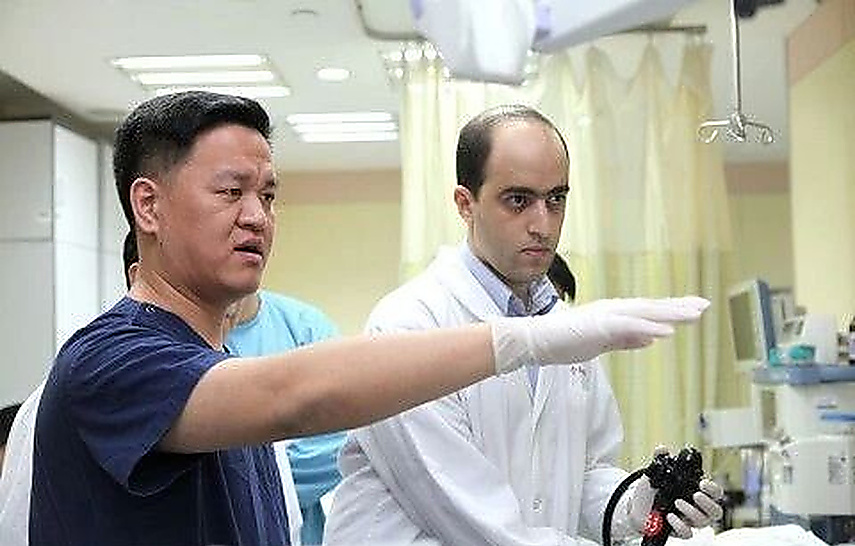
Dr. Zhong Yunshi | Endoscopic Surgery, and a Small Sharp Knife for Hard Cases
Dr. Jiang Jingjing | Endocrinology, and the Detective Work of Medicine
Dr. Zhang Guolong | Disease Prevention and Control, and Quiet Strength
Dr. Zhu Zhengfei | Radiation Oncology, and Perhaps We Need to Learn from Tumor Cells
Dr. Zhao Yiming | Liver Surgery, and No Overnight Success, Only Perseverance
Dr. Zhao Kuaile | Radiation Oncology, and the Great Way Is Simple
Dr. Gu Chaoying | Dermatology, and Holding On Because There Is No Other Choice
Dr. Wang Qunshan | Cardiac Electrophysiology, and Meeting the Rising Wind
Copyright © 2023 Yewen Renyi & ShanghaiDoctor.cn (This website is a non - profit medical humanities platform. The information contained herein is solely for biographical and historical purposes and does not constitute any medical advice.) 沪ICP备2023005392号-2 XML 沪公网安备31010902100835号
 中文
 English
 Español
 沪公网安备31010902100835号
